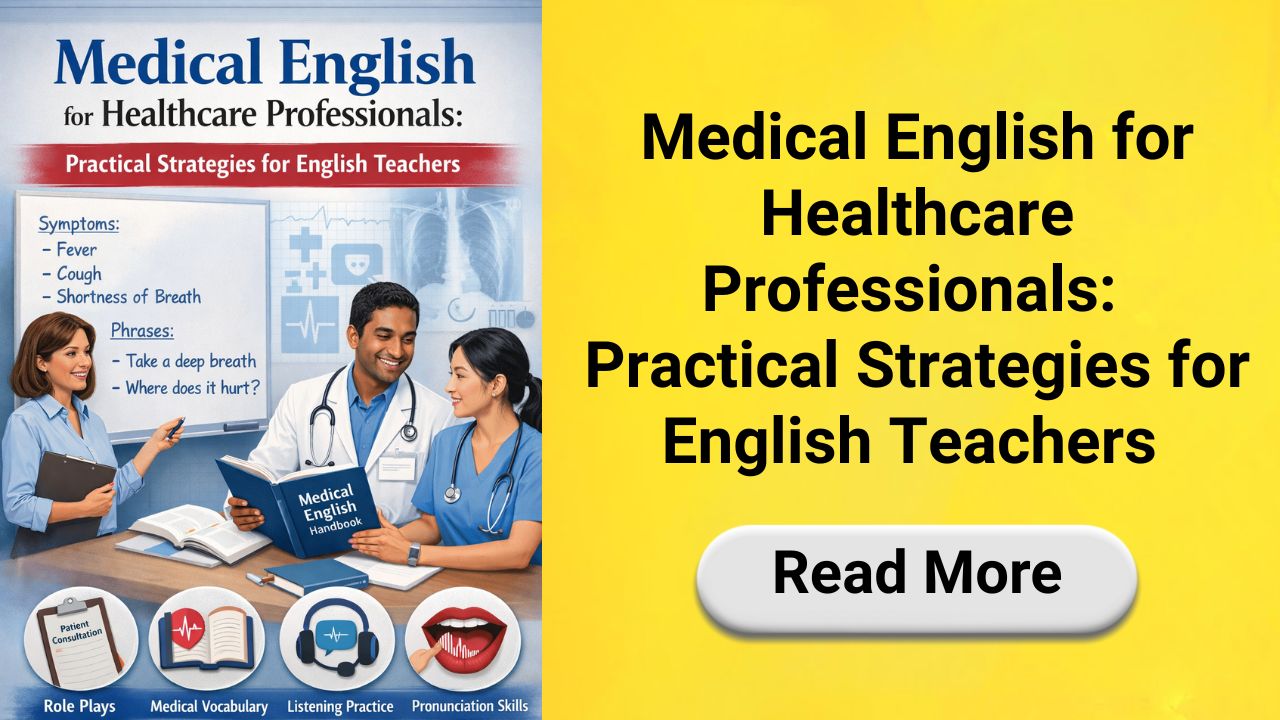
In a hospital emergency room, communication is never “just practice.” It is about clarity, safety, and responsibility. That is why English for Medical Purposes is one of the most promising and well-paid niches for English teachers who want to specialize and grow professionally.
Teaching specialized English (ESP) requires deeper preparation than teaching General English. You need to understand the professional context of doctors, nurses, and medical staff, typical communication scenarios, essential terminology, and—most importantly—how to turn all of this into practical, scenario-based lessons rather than simple vocabulary lists. This level of expertise deserves higher rates and professional recognition, because you are solving real workplace communication problems.
In this guide, I’ll show you how to position yourself in the medical English teaching niche, what skills and materials you need to start, how to integrate ESP and CLIL into your lessons, and how to expand medical vocabulary systematically—without overwhelming your students.
Medical English Terminology: Where to Start as a Teacher
When teachers hear “medical English terminology,” it can feel intimidating. Hundreds of abbreviations, Latin-based words, and technical expressions. The key is not to start with the dictionary—but with your learners’ needs.
Are your students doctors, nurses, medical students, hospital receptionists, or interpreters? Begin with a short needs analysis. Identify their most frequent communication tasks: patient safety, accurate documentation, explaining procedures, polite interaction. From that moment, every term becomes a tool—not the goal itself.
Organizing Vocabulary in Practical Blocks
Instead of teaching isolated words, structure your course around realistic communication blocks:
- Vitals: blood pressure (BP), heart rate (HR), respiratory rate (RR), oxygen saturation (O2 sat)
- Taking a history: chief complaint, onset, duration, severity, pain scale 0–10
- Medication and prescriptions: dosage, PRN, BID/TID, q4h, STAT
- Discharge: follow-up, warning signs, written instructions
Each block should include 1–2 realistic scenarios and a limited set of essential phrases. This helps learners see measurable progress and avoid overload.
🎓 Get a
TEFL &
TESOL course and certificate with a 50% discount!
And start earning money 💸 by teaching English in your own country, abroad, or online from anywhere on the planet! 🎁 Gifts and bonuses: professional support from your personal coach 🧑🏫 and job placement assistant 💼.
Medical English Vocabulary: Teach for Context, Not for Memorization
Medical English vocabulary only becomes powerful when embedded in real situations. For example, instead of teaching random verbs, build functional sets:
- assess, inject, suture, admit, refer
- rule out a condition
- respond to treatment
- present with symptoms
Teach collocations and sentence patterns. Combine vocabulary with immediate speaking practice and feedback. That is how confidence develops.
High-Impact Communication Phrases
- Taking complaints: When did it start? / What makes it better or worse? / Do you have any allergies?
- Explaining procedures: I’m going to examine your abdomen. Is that okay?
- Ensuring safety: On a scale from zero to ten, how bad is the pain?
- Medication instructions: Take one tablet twice a day after meals.
English for Medical Professionals: Course Structure
For a course in English for medical professionals, combine ESP methodology with task-based learning and role plays. The structure is simple:
- Short vocabulary input.
- Mini case study.
- Role play practice (doctor–patient, nurse–patient, doctor–doctor).
- Feedback and language refinement.
Keep every module focused on tasks that learners actually perform during a shift: greeting a patient, verifying identity, explaining procedures, checking understanding, documenting information.
This course format is also highly relevant for medical interpreters. In hospitals, interpreters are not simply translating words—they are ensuring accurate understanding between doctor and patient. Teaching specialized medical English helps them avoid miscommunication and build professional confidence.
🚀 Get a free 12-step checklist for increasing your income as an English teacher!
💡 Unlock the secrets to doubling your teaching income with our exclusive checklist! 🎯 This checklist is designed for English teachers who want to 📈 attract more students and 🔥 keep them engaged for the long term.
Example 90-Minute Lesson Plan
- Warm-up discussion: communication challenges in hospitals.
- Target vocabulary with symptom-action collocations.
- Case study analysis (identify safety risks).
- Timed role-play rotations (3–5 minutes per scenario).
- Short SBAR oral report.
- Reflection and phrase expansion.
TEFL/TESOL as a Methodology Foundation for Medical English Teachers
If you’re building a medical English program, a strong teaching framework matters as much as the vocabulary. A solid TEFL/TESOL foundation helps you structure lessons, plan skills work, manage mixed levels, and design effective practice—especially in high-stakes contexts like healthcare. The most useful takeaway from TEFL and TESOL training is not “more theory,” but a reliable toolkit: needs analysis, communicative lesson staging, task design, error correction strategies, and assessment methods you can adapt to English for Medical Purposes.
In practice, TEFL/TESOL principles pair naturally with ESP (professional task focus) and CLIL (simple medical content + language objectives). That combination keeps lessons realistic, measurable, and learner-centered—so students leave class with phrases and routines they can use on the job, not just lists they forget.
Patient Communication in English: Tone and Empathy
Teaching patient communication in English goes beyond grammar. It includes tone, empathy, clarity, and cultural awareness.
Train your learners to:
- Introduce themselves clearly: Hello, my name is… I’m your nurse today.
- Explain procedures step by step.
- Use paraphrasing: So the pain started this morning, correct?
- Check understanding: Could you repeat the instructions in your own words?
Encourage “plain English” when speaking to patients. Replace technical jargon with accessible language:
- Hypertension → High blood pressure
- Myocardial infarction → Heart attack
Assessment: Measuring Progress in Medical English Courses
To ensure your course is effective, use three clear indicators:
- Each lesson closes a specific communication scenario.
- Students can use 10–12 key phrases accurately.
- Final OSCE-style simulation with measurable criteria.
Assessment criteria may include politeness, clarity, completeness, accuracy, and time management. Avoid purely written exams—prioritize spoken performance in realistic contexts.
🔥 How to enter the international market with TEFL/TESOL and start earning by teaching English — online, abroad, or in your own country.
🚀 We’ll show you how to upgrade your English teaching career — whether you’re starting from scratch or already have experience. We’ll explain how a TEFL/TESOL certificate can help you grow your career online and offline — in your own country or abroad. We’ll also walk you through how our all-in-one training works, with a personal tutor and job placement support.
Expanding the Course Without Overloading Students
After covering core scenarios (intake, vitals, procedures, discharge), add focused “communication sprints”:
- Triage and emergency communication
- Pediatrics
- Diabetes management
- Mental health interactions
- Telemedicine consultations
Each sprint should include 20–30 high-frequency phrases and 1–2 case simulations. Use spaced repetition to reinforce retention.
Methodology: ESP and CLIL for Medical English Teachers
Three approaches work especially well in medical English teaching:
- ESP (English for Specific Purposes) – focus on professional tasks.
- Task-Based Learning – measurable communication outcomes.
- CLIL (Content and Language Integrated Learning) – integrate simple medical content with language goals.
You do not need a medical degree to teach medical English. Your role is to teach communication clearly, ethically, and safely—not to provide medical advice.
🎉 Get your
free practical book: 📖 “20 Ready-Made
EFL &
ESL Lesson Plans for English Teachers”.
💼 Less preparation - more engagement and results in lessons. 🔹 20 topics: family, hobbies, travel, debates and much more 🔹 For beginners and experienced teachers 🔹 Fully ready-made lessons - open and conduct lessons easily! 🔥 Save time and make lessons interesting and effective
📚 Download lesson plans
Common Questions from English Teachers
Do I need medical training?
No. You need structured scenarios, clear communication goals, and professional boundaries.
How do I handle mixed language levels?
Use station-based tasks. Lower-level students practice core phrases. Advanced students add paraphrasing and polite clarification strategies.
How can I increase my rates?
Position yourself as a specialist in English for medical professionals. Demonstrate structured course outcomes, realistic simulations, and clear assessment criteria.
Conclusion: Why Medical English Is a Smart Niche
Medical English for healthcare professionals is not just another specialization—it is a high-impact, high-value niche for English teachers. It combines language expertise with real-world application, improves patient safety, and opens doors to premium clients.
Start small: one scenario, one vocabulary block, one structured role play. Build your materials systematically. With the right methodology, you can create a course that is practical, ethical, and professionally rewarding—for both you and your students.
Terms used:
CLIL, EFL, ESL, ESP, TEFL, TESOL