Blog for ESL teachers
Practical tips, methods, and materials for successful teaching
Have you ever thought, “If only agreements could write themselves in perfect English”? If yes, we’re on the same page. For me, Legal English is not about archaic terms — it’s about logic, structure, and clarity that save hours of work and keep clients calm. In this guide, I’ll walk you through essential Legal English vocabulary and show how to approach drafting legal documents in English so your writing sounds confident and professional. (Yes, that “legal English vocabulary” everyone searches for.)
Have you ever caught yourself thinking, “I want less explaining—more doing”? That’s exactly what project-based learning in English delivers: learners create a visible product, use language for real purposes, and finally stop asking “why do I need this?”. In the world of ELT, this approach is called project-based learning (PBL). In a project-based learning ELT context, it works beautifully—even with tight schedules and mixed-ability classes.
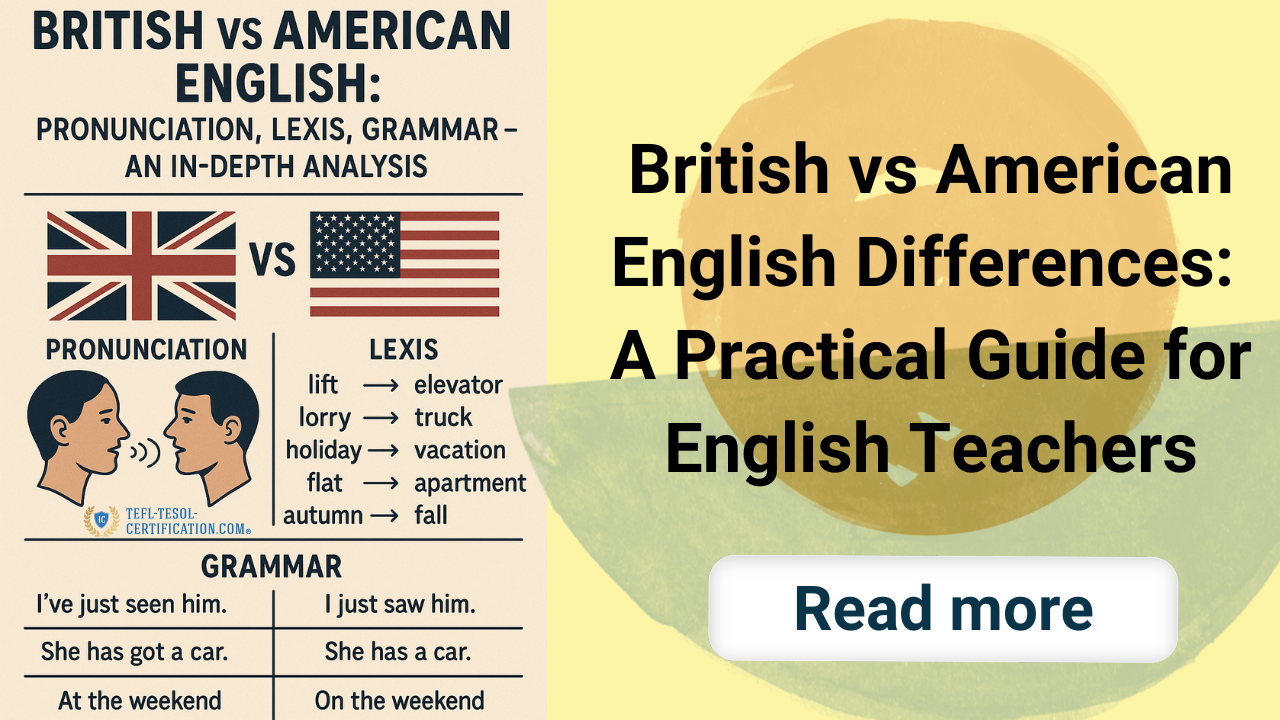
English learners often ask: “Which is correct — at the weekend or on the weekend?”, “Color or colour?”, “Did you get my mail or post?”, “Flat or apartment?”, “Is schedule pronounced /ˈʃedjuːl/ or /ˈskedʒuːl/?”
Questions like these turn into a ready-made lesson on British and American English differences. Below we unpack the most frequent classroom questions about pronunciation, vocabulary, and grammar, show why both varieties are valid in their own traditions, and outline how to decide which English to teach for different learner goals. 😊
Have you seen a learner ready to speak—lips parted, idea formed—then freeze mid-sentence? It’s not shyness; it’s a paralyzing fear of being wrong. That fear can make every word feel risky. The student worries about being misunderstood, laughed at, or “saying it wrong,” and speech locks up more tightly than any grammar gap ever could. At that moment, the teacher’s job isn’t to correct; it’s to restore safety. Behind that fear sits enormous growth potential: once learners understand that an error isn’t failure but a step in the process, their speech comes alive and confidence follows.
This article shows how to help students overcome the fear of making mistakes in English and turn it into a tool for progress—practically, compassionately, and efficiently.
You probably know that feeling: a lesson flows perfectly, ideas come one after another — and suddenly you want to capture those thoughts, structure them, and bring students into a real discussion. That’s when online whiteboards become more than just a convenient tool — they turn into a shared thinking space. They help visualize language, make the abstract tangible, and transform even simple exercises into a live exchange of ideas. Below is my honest and practical guide to using Miro and Mural effectively in English lessons — without overload, and with maximum impact. 😊
and start earning by teaching English in your country, abroad, or online from anywhere in the world! Order the course with a 50% discount 💸 and receive as a gift the support of a personal coach 👨🏫 and job placement assistant! 🎁🚀 Hurry, limited spots available! 🏃♂️💨
💡 Unlock the secrets to doubling your teaching income with our exclusive checklist! 🎯 This checklist is designed for English teachers who want to 📈 attract more students and 🔥 keep them engaged for the long term.
🚀 More students, 💰 higher income, 🌍 complete freedom! ✅ 112 verified platforms with top rates ⏳ Flexible schedule – work whenever and as much as you want 🎯 Simple requirements – start earning right away 💎 Boost your career and income by teaching students worldwide!