Have you ever had one of those evenings when you still had an English lesson ahead of you, your students were tired, and you needed something fresh that would immediately bring energy back into the room? I know that feeling very well. More than once, the right YouTube video saved a lesson for me. It solved the motivation problem, gave me a strong listening task, and opened the door to a meaningful speaking activity at the same time.
Advanced Travel English is designed for learners who want to feel confident abroad and communicate naturally in real-life situations. It’s not just about airports or hotels—it’s about handling conversations with staff, asking for help, joining tours, dealing with emergencies, or chatting with locals. At this level, students should not only know phrases but also understand tone, subtext, and cultural nuance. The goal is to sound natural, polite, and context-aware.
Idioms are part of the DNA of any language. They make speech vivid, memorable and emotionally precise in ways that “ordinary” vocabulary often can’t. Once students start using idioms, they sound far more natural and much closer to real-life English. And a huge number of common English idioms are built around animals: they describe personality, social situations, business life and more. In this article, we will look at popular animal idioms in English and how to teach them so that learners not only understand the meaning, but also feel confident using these expressions in real communication.
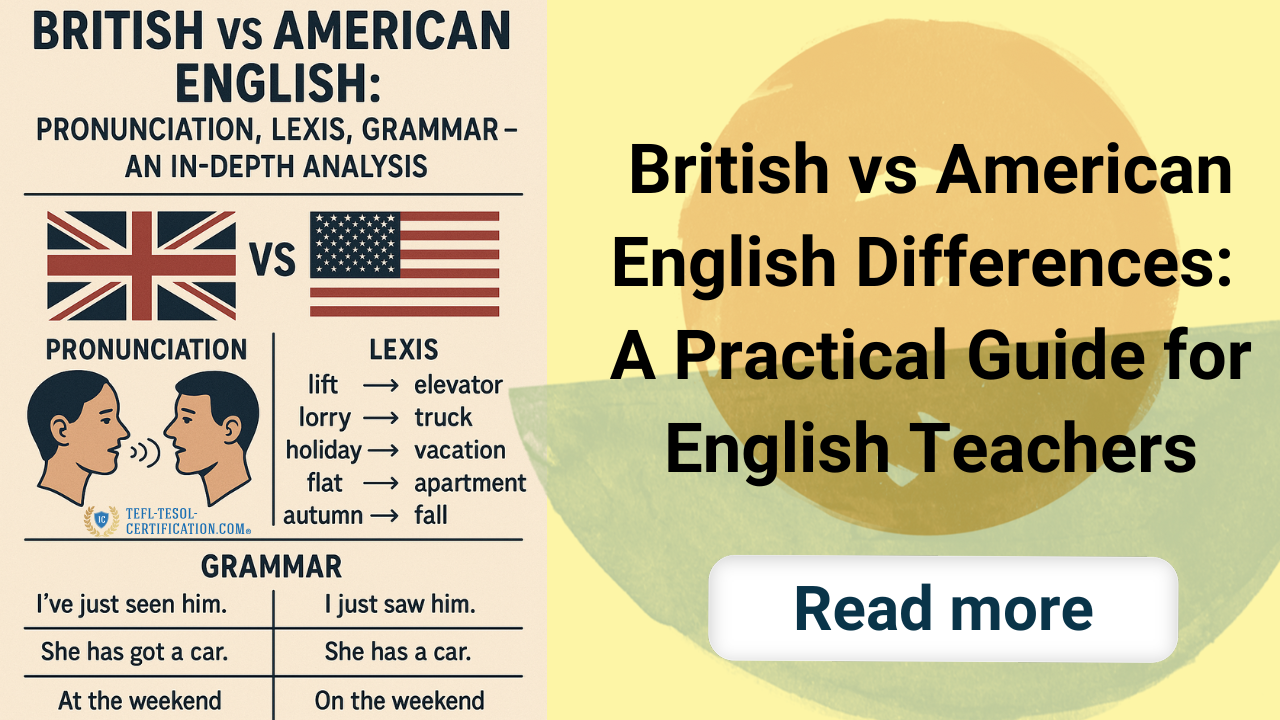
English learners often ask: “Which is correct — at the weekend or on the weekend?”, “Color or colour?”, “Did you get my mail or post?”, “Flat or apartment?”, “Is schedule pronounced /ˈʃedjuːl/ or /ˈskedʒuːl/?”
Questions like these turn into a ready-made lesson on British and American English differences. Below we unpack the most frequent classroom questions about pronunciation, vocabulary, and grammar, show why both varieties are valid in their own traditions, and outline how to decide which English to teach for different learner goals. 😊
Business English exams such as BEC (Business English Certificate) and BULATS (Business Language Testing Service) are international tests that measure how confidently candidates can use English in professional and corporate contexts. They are especially relevant for learners who work or plan to work in international companies, run their own business, study business or management, and want an official certificate proving their level of Business English.
In this article, we will look at the structure and levels of the BEC exams, discuss how they relate to modern BULATS-style testing, and, most importantly, focus on how English teachers can build effective training programmes that help adults pass these exams and use Business English at work.
and start earning by teaching English in your country, abroad, or online from anywhere in the world! Order the course with a 50% discount 💸 and receive as a gift the support of a personal coach 👨🏫 and job placement assistant! 🎁🚀 Hurry, limited spots available! 🏃♂️💨
🚀 Get a free 12-step checklist for increasing your income as an English teacher!
💡 Unlock the secrets to doubling your teaching income with our exclusive checklist! 🎯 This checklist is designed for English teachers who want to 📈 attract more students and 🔥 keep them engaged for the long term.
🔥 How to enter the international market with TEFL/TESOL and start earning by teaching English — online, abroad, or in your own country.
🚀 We’ll show you how to upgrade your English teaching career — whether you’re starting from scratch or already have experience. We’ll explain how a TEFL/TESOL certificate can help you grow your career online and offline — in your own country or abroad. We’ll also walk you through how our all-in-one training works, with a personal tutor and job placement support.
🎉 Get your free practical book: 📖 “20 Ready-Made EFL & ESL Lesson Plans for English Teachers”.
💼 Less preparation - more engagement and results in lessons. 🔹 20 topics: family, hobbies, travel, debates and much more 🔹 For beginners and experienced teachers 🔹 Fully ready-made lessons - open and conduct lessons easily! 🔥 Save time and make lessons interesting and effective